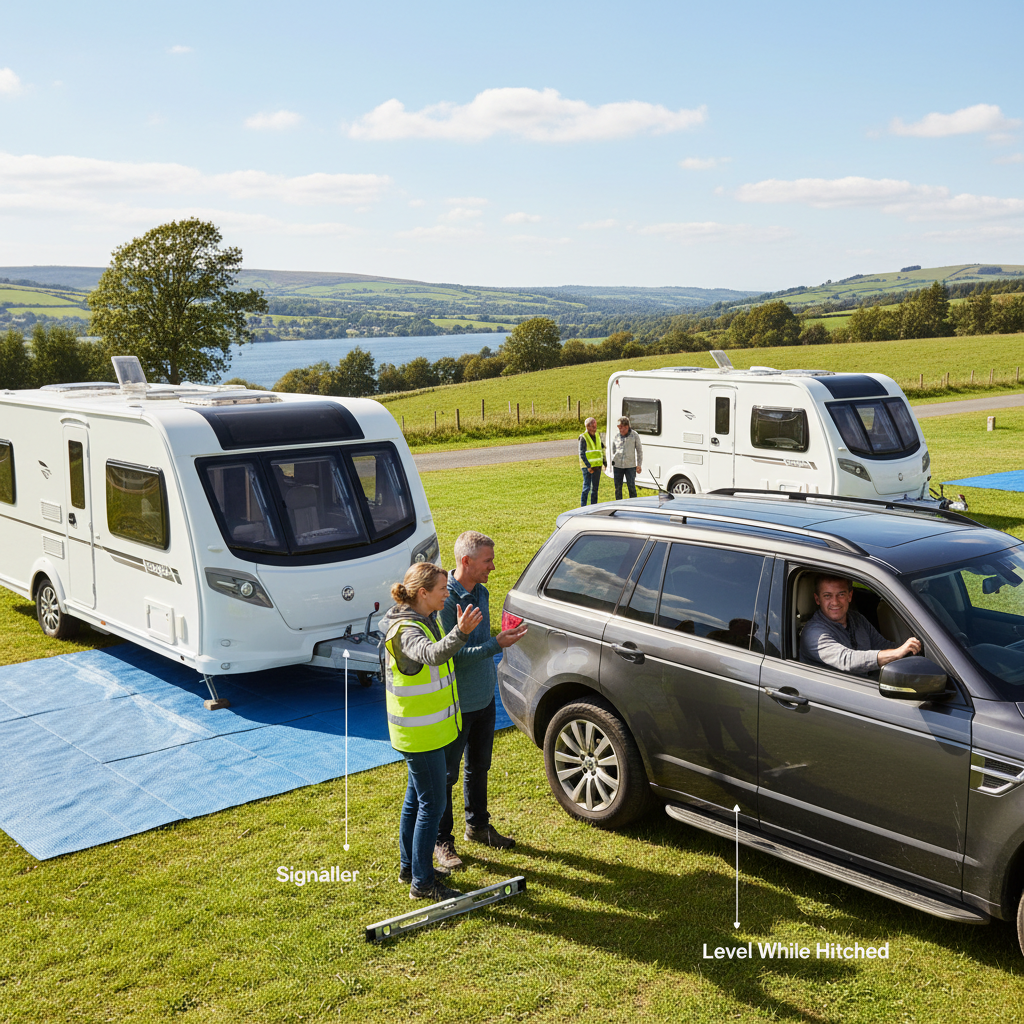
TL;DR: The Stress-Free Setup
- Define Roles: Assign a 'Signaller' and 'Driver' before manoeuvring to avoid miscommunication.
- Level While Hitched: Side-to-side levelling must be completed before unhitching the car.
- Steady Rule: Corner steadies are for stability only; never use them to lift or level the chassis.
- Utility Sequence: Connect Electric, then Water, then Waste for maximum efficiency.
- Safety Chocks: Always secure wheels before releasing the hitch on any gradient.
Pitching a caravan can be the most stressful part of a holiday. When everyone talks at once and roles aren't defined, it leads to the infamous 'site argument'. However, a disciplined five-minute routine—updated for 2026 standards—ensures you are level, safe, and ready for a brew in record time. Whether you are towing a lightweight Swift Basecamp Plus or a twin-axle Adria Alpina, the principles of physics remain the same.
The Five-Minute Arrival Routine
1. The 'Stop & Survey' (1 Minute)
Before reversing onto the pitch, stop the car. Both occupants should get out to inspect the ground for soft patches, low-hanging branches, or hidden service bollards. This is the moment to decide who is directing and who is driving. If you are using a motor mover, ensure the handset is charged and the caravan handbrake is off only once the rollers are engaged. For those new to towing, checking your outfit's compatibility on our Caravan Towing Calculator before your trip ensures you arrive with confidence.
2. Side-to-Side Levelling (1 Minute)
It is a common mistake to unhitch before levelling. Use a spirit level on the floor or A-frame. If the pitch is uneven, pull or reverse the caravan onto a levelling ramp while still hitched to the car. Once level side-to-side, apply the caravan handbrake and chock the wheels on both sides. This is particularly vital for modern Caravan Layouts with sensitive AL-KO ATC systems or heavy end-washrooms.
3. Unhitching and Front-to-Back Levelling (1 Minute)
Disconnect the 13-pin electrics and the breakaway cable. Lower the jockey wheel and unclamp the hitch. Once the car is moved away, use the jockey wheel to adjust the front-to-back level. If you find your noseweight was consistently high during the journey, it may be worth reviewing your loading plan or browsing different Caravan Models designed with better weight distribution.
4. The 'Steady' Rule (1 Minute)
Lower the corner steadies. Crucial: These are for stability, not for lifting the caravan. If you try to level the van using the steadies, you risk warping the chassis or damaging the floor. Use a cordless drill with a socket attachment to speed this up, but finish the last few turns by hand to feel the resistance. For heavier vans like the Bailey Unicorn Cartagena, ensure your 'big feet' pads are securely attached to prevent sinking.
5. Services and Internal Check (1 Minute)
Connect in this order: Electric (Hook-up), Water (Aquaroll), then Waste (Wastemaster). Connecting electrics first allows the fridge to switch from 12V to 230V immediately. Finally, step inside and ensure all lockers stayed shut during transit before the 'unpacking chaos' begins. Check that your internal control panel is set to 'Van' rather than 'Car' to avoid draining your leisure battery.
Safety Checklist for 2026
- Breakaway Cable: Ensure it is looped through the dedicated attachment point on the towbar, not just over the towball.
- Handbrake: Fully engaged before unhitching, especially on inclines.
- Gas: Ensure the gas bottle is turned off at the valve during transit (unless using a crash-sensing regulator like Truma MonoControl).
- Tyres: Check for flat spots, sidewall damage, or pressure loss immediately after a long haul.
- Torque Check: For 2026 safety compliance, it is recommended to check wheel bolt torque after the first 30 miles of a trip, and visually inspect at the pitch.
Frequently Asked Questions
Should I level the caravan before or after unhitching?
Side-to-side levelling should always be done while hitched (or using a motor mover). Front-to-back levelling is done after unhitching using the jockey wheel to prevent unnecessary strain on the car's suspension and to ensure the caravan doesn't roll.
Is a breakaway cable mandatory?
Yes, under UK law, all braked trailers (including caravans) must be fitted with a breakaway cable that applies the brakes if the hitch fails. Failure to use one correctly can result in a fine and points on your licence.
What if the ground is very soft?
Use 'spreader plates' or 'feet' on your steadies to prevent them from sinking into the grass over time. In extreme cases, wooden planks under the wheels can prevent the caravan from becoming bogged down.
Can I use my corner steadies to change a tyre?
No. Never use corner steadies to lift the caravan for maintenance. Always use a dedicated jack rated for your caravan's MTPLM, ideally using the specific jacking points on the chassis.
The best caravanners are not those with the newest Caravan Models; they are the calmest. A repeatable routine creates a stress-free environment for the whole family and ensures your equipment lasts for years to come. For more help finding a caravan that is easy to pitch, Find a Dealer near you to test out different motor mover setups.
