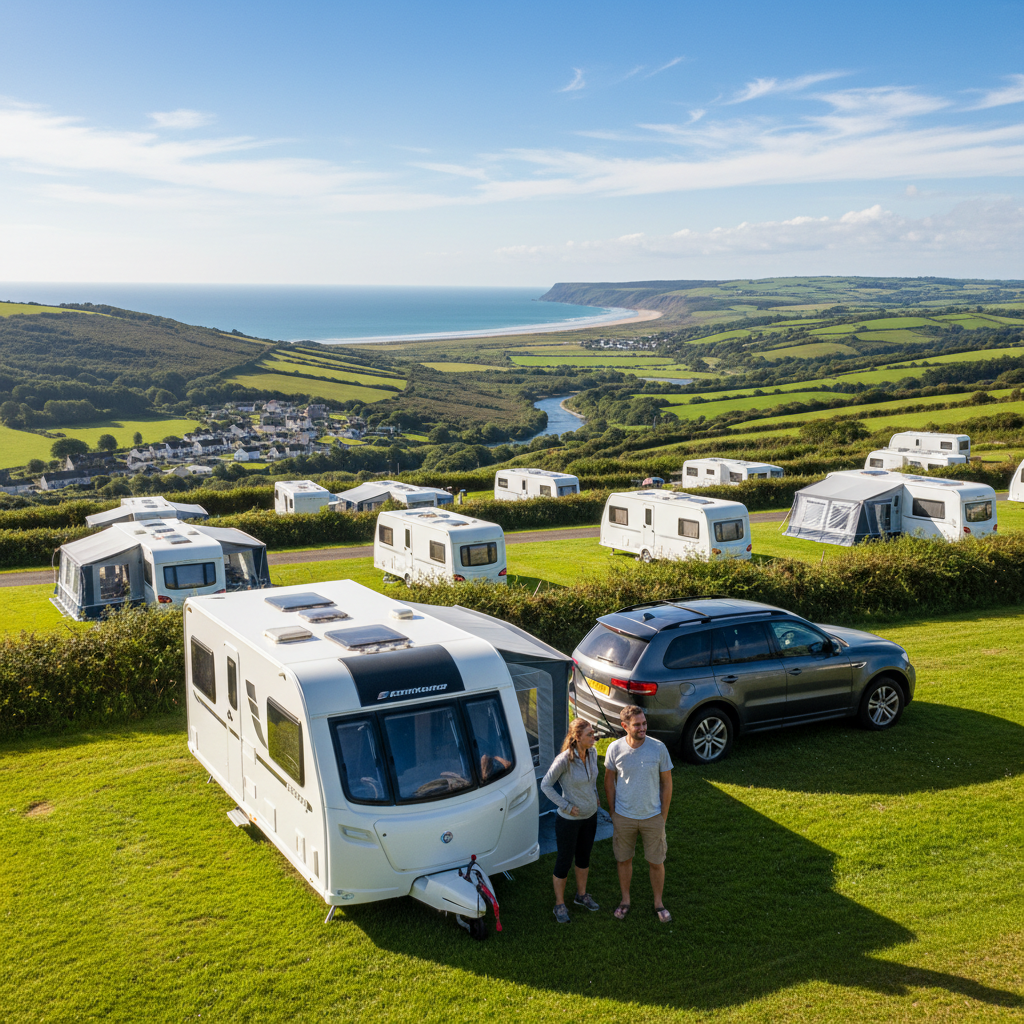
Should you buy a caravan? The honest answer
Caravanning offers genuine freedom: no hotel bookings, your own bed every night, and access to the UK's best sites at a fraction of B&B costs. But it's not for everyone. You need a suitable tow car, somewhere to store it when you're not using it, and the patience to learn reversing (it's easier than people think). If that sounds manageable, this guide will walk you through everything you need to know.
Step 1: Check what your car can tow
Before falling in love with a caravan, you need to know your car's limits. Every car has three key numbers you must understand:
- Kerbweight – The weight of your car with fluids but no passengers or luggage
- Maximum towing capacity – The absolute limit set by the manufacturer
- Gross Train Weight (GTW) – The maximum combined weight of car, caravan, and everything inside both
You can find these on your V5C logbook or use our free towing calculator to check all three instantly by entering your registration.
Step 2: Understand the 85% rule
The 85% rule is the golden guideline for safe, stable towing. It states: your caravan's MTPLM (Maximum Technically Permissible Laden Mass) should not exceed 85% of your car's kerbweight. This isn't law, but it's the standard recommended by the Caravan and Motorhome Club and most experienced caravanners.
Example: If your car weighs 1,500kg, you should tow a caravan with an MTPLM no greater than 1,275kg (1,500 × 0.85).
Exceeding 85% doesn't make towing illegal, but it increases sway risk, reduces braking efficiency, and makes the outfit harder to control in crosswinds.
Step 3: Know the weight terms
Caravan weight terminology confuses most first-timers. Here's what each term actually means:
| Term | What it means | Why it matters |
|---|---|---|
| MTPLM | Maximum Technically Permissible Laden Mass | The maximum loaded weight your caravan can legally carry. This is the figure to compare against your 85% calculation. |
| MIRO | Mass In Running Order | The caravan empty with standard equipment and full gas/water. The starting point for working out payload. |
| Payload | MTPLM minus MIRO | How much you can actually load inside. Aim for at least 150kg for couples, 200kg+ for families. |
| Noseweight | Downward force on the towball | Typically 50-100kg. Your car has a maximum noseweight limit too, check it matches. |
Step 4: Licence requirements for towing
If you got your car licence from 1 January 1997, current GOV.UK guidance says you can tow a trailer up to 3,500kg MAM under category BE entitlement. The 3,500kg figure is not a blanket combined car-plus-caravan limit; you must also stay within the tow vehicle manufacturer's towing limit and Gross Train Weight.
The separate B+E car-and-trailer test was removed in Great Britain in December 2021. Check your individual licence record and current GOV.UK guidance before relying on an entitlement.
Our towing calculator checks your licence requirements automatically based on the weights you enter.
Step 5: What to check when viewing a caravan
This is where first-timers often go wrong. Don't get distracted by upholstery or fancy gadgets. Focus on the fundamentals:
Priority checks (walk away if these fail)
- Damp – The single biggest caravan killer. Ask for a recent damp report (within 12 months) or bring your own meter. Check around windows, skylights, and the front/rear panels. Any readings above 15% need investigation.
- Chassis condition – Look for rust, especially around the A-frame, axle, and corner steadies. Surface rust is normal; structural rust is a deal-breaker.
- Service history – A caravan serviced annually is worth more than one that's been neglected. Ask for receipts.
Secondary checks
- Tyres – Check tread depth and manufacturing date (stamped on sidewall). Replace if over 5 years old regardless of tread.
- Brakes – Engage the handbrake and try to push the caravan. It shouldn't budge.
- Electrics – Test all 12V and 230V sockets, lights, water pump, and control panel.
- Gas system – Check appliances light correctly and the gas locker seal is intact. Gas systems need professional certification every 3 years.
- Windows and seals – Open every window, check hinges aren't cracked, and seals aren't perished.
Step 6: Common first-timer mistakes to avoid
We see these errors repeatedly:
- Buying too big – A 6-berth sounds sensible but weighs more, costs more to store, and is harder to tow. Match berths to actual sleeping needs.
- Ignoring payload – A caravan with 80kg payload sounds fine until you add an awning (40kg), bedding, and supplies. You'll be overweight before you leave the driveway.
- Skipping the damp check – "It's been stored inside" means nothing. Damp enters through seals, not rain. Always check.
- Forgetting running costs – A £8,000 caravan with £1,200/year storage, £300 insurance, and £250 servicing costs £1,750 annually before you've gone anywhere.
- Buying from photos alone – Private sales especially. Always view in person, ideally in daylight.
Step 7: Budget beyond the purchase price
First-time buyers often underestimate ongoing costs. Here's a realistic breakdown for 2026:
| Cost | Annual estimate | Notes |
|---|---|---|
| Storage | £500-1,500 | CaSSOA-approved sites cost more but offer better security |
| Insurance | £200-400 | Specialist caravan insurers like Caravan Guard often beat general insurers |
| Servicing | £200-350 | Annual service essential for warranty and safety |
| Site fees | £25-50/night | Caravan Club sites average £28-35; private sites vary widely |
| Essential accessories | £300-800 (one-off) | Awning, levelling blocks, aquaroll, wastemaster, towing mirrors |
Step 8: When to buy (seasonal tips)
Timing matters more than most buyers realise:
- Best prices: October to February. Dealers are quieter, private sellers are motivated before storage renewals.
- Worst prices: March to May. Everyone's preparing for the season and demand peaks.
- Show season: The NEC Caravan Show (October) and spring shows offer deals, but crowds make viewing difficult. Visit dealers the week after shows when they're well-stocked but less busy.
Recommended first caravans for 2026
For first-timers, we recommend lightweight 2-4 berth tourers from established brands with good dealer networks:
- Swift Sprite or Challenger – Reliable, widely available, excellent resale value
- Bailey Phoenix or Discovery – Solid build quality, competitive pricing, good payload figures
- Elddis Avante or Affinity – Lightweight options, thoughtful layouts, SoLiD construction
- Lunar (used) – No longer in production but excellent quality second-hand
Browse all used caravans for sale, or filter by fixed bed layouts, 2-berth, or 4-berth models.
Your first-timer checklist
Print this or screenshot it for viewings:
- Car towing limits checked (use our calculator)
- Caravan MTPLM within 85% of car kerbweight
- Licence requirements confirmed
- Damp report obtained or own meter used
- Service history reviewed
- Chassis and A-frame inspected for rust
- All electrics tested (12V, 230V, lights)
- Gas appliances checked
- Tyres inspected (tread and age)
- Payload calculated with your gear
- Storage solution arranged
- Insurance quotes obtained
Ready to start searching?
Use our towing calculator first to establish your weight limits. Then browse used caravans filtered to match your car. Set up an alert for your criteria and we'll notify you when matching caravans are listed.
