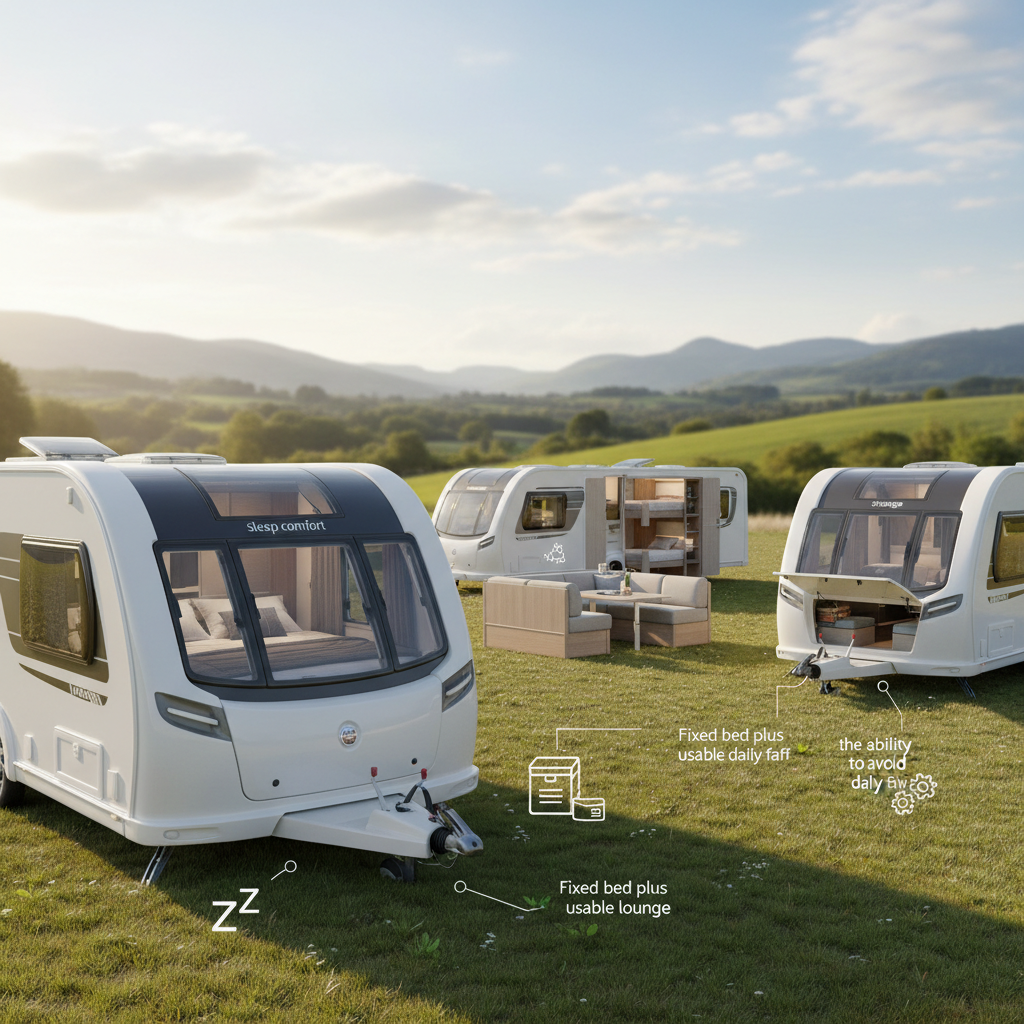
January 2026 Layout Snapshot: Key Takeaways
- Fixed Beds Reign Supreme: Transverse and island beds remain the #1 priority for 2026 buyers to avoid the 'daily faff' of bed making.
- The 'Zoned' Family Layout: Rear bunk rooms with dedicated seating are seeing a 15% surge in search volume compared to traditional side-dinettes.
- Payload Awareness: With heavier tech specs in 2026 models, layout choice is now being dictated by MTPLM constraints and B+E driving licence requirements.
- Washroom Evolution: Full-width end washrooms are now considered a 'must-have' for the used market resale value.
Buyer attention in the UK caravan market is rarely random. As we enter the 2026 season, layout interest is following three predictable pressure points: sleep comfort, storage efficiency, and the elimination of 'daily faff'. With more tech integrated into the chassis than ever before, the choice of floorplan is no longer just about aesthetics—it is about weight management and lifestyle flow.
High-Interest Layout Themes for 2026
1. Fixed Beds with Uninterrupted Lounges
The trend toward permanent sleeping quarters has solidified. Buyers are increasingly prioritising models like the Bailey Alicanto Grande Deluxe Porto or the Swift Challenger SE 480, where the bed remains a bed. The 'transverse island bed' remains the gold standard for 2026, offering accessibility from both sides without sacrificing floor space during the day. This configuration is particularly popular in the 8ft-wide 'Grande' ranges, such as the Bailey Alicanto Grande Deluxe Alvor, which provides extra walkway space around the foot of the bed—a critical factor for accessibility.
2. Dedicated Family Zones
The days of converting the main dinette for children are fading. Modern buyers are looking for 'zoned' living. Layouts featuring rear bunk pods or dedicated 'kids' snugs'—seen in models like the Bailey Phoenix Plus 440—allow adults to maintain a usable lounge after the children have gone to sleep. We are seeing a specific rise in 'flexible bunk' designs where the bottom bunk can be folded up to create a garage space for bikes and outdoor gear, catering to the growing 'active outdoors' demographic.
3. The 'Dressing Room' Washroom
End washrooms are no longer just about the toilet and shower; they are being used as private changing areas. A full-width rear washroom provides the necessary floor space to get dressed comfortably, a feature that often outweighs 'glossy fittings' in long-term satisfaction surveys. Models like the Elddis Riva 554 and the Swift Challenger 645 continue to lead this category by offering boutique-hotel styling in the rear quarters, often including heated towel rails and integrated wardrobes.
Why Certain Layouts are Losing Traction
Layouts requiring complex daily transformations are seeing a decline in 'save' rates on digital platforms. If a floorplan requires the 'Tetris-style' movement of cushions while occupants are hungry or tired, it quickly drops down the shortlist. In 2026, convenience is the true luxury—not beige leather or ambient lighting. Traditional two-berth layouts with small side-kitchens are being overlooked in favour of more spacious 'L-shaped' kitchen configurations that offer better workflow and more worktop real estate for air fryers and coffee machines.
Weight and Licence Considerations for 2026
As layouts grow wider and more tech-heavy, the Maximum Technically Permissible Laden Mass (MTPLM) is creeping upwards. It is vital to cross-reference your chosen layout with your driving licence. While the 2021 law change simplified towing for many, heavy twin-axle models like the Bailey Pegasus Grande GT75 Bologna still require a capable tow car. Use our Caravan Towing Calculator to ensure your outfit is safe and legal.
Practical Steps for Buyers
- Shortlist by Layout First: Use our Caravan Layouts hub to filter by your 'must-have' bed configuration before looking at brands.
- Check the Payload: Fixed-bed layouts often result in heavier unladen weights. Ensure you have enough remaining payload for your personal kit.
- Test the 'Walk-through': Visit a local dealer and physically walk from the door to the washroom with the bed extended. If you have to shuffle sideways, the layout may be too cramped.
- Consider the Axle: Twin-axle models offer superior stability but can be harder to manoeuvre on tight pitches without a motor mover.
- Verify MTPLM: Ensure the MTPLM does not exceed your car's towing capacity or your driving licence limits.
Frequently Asked Questions
Which caravan layout has the best resale value?
Typically, four-berth layouts with a fixed island bed and a large end washroom (like the Coachman Laser 665 or Bailey Alicanto Grande Deluxe Sintra) retain their value best due to high demand in the used market.
Are twin-axle layouts worth the extra weight?
Twin-axle models offer superior stability and significantly more internal 'elbow room'. However, you must verify your vehicle's towing limits. For those seeking maximum space on a single axle, the Adria Adora range often provides clever weight-saving layouts. Check our Caravan Models hub for weight specifications.
What is the best layout for working from home (WFH)?
In 2026, layouts with a 'central' or 'mid-dinette' are popular for digital nomads, as they provide a dedicated desk space that doesn't interfere with the main lounge or the fixed bed.
Next step: Browse our comprehensive guide to Caravan Models or start a shortlist that fits how you actually travel, not just how the brochure looks.