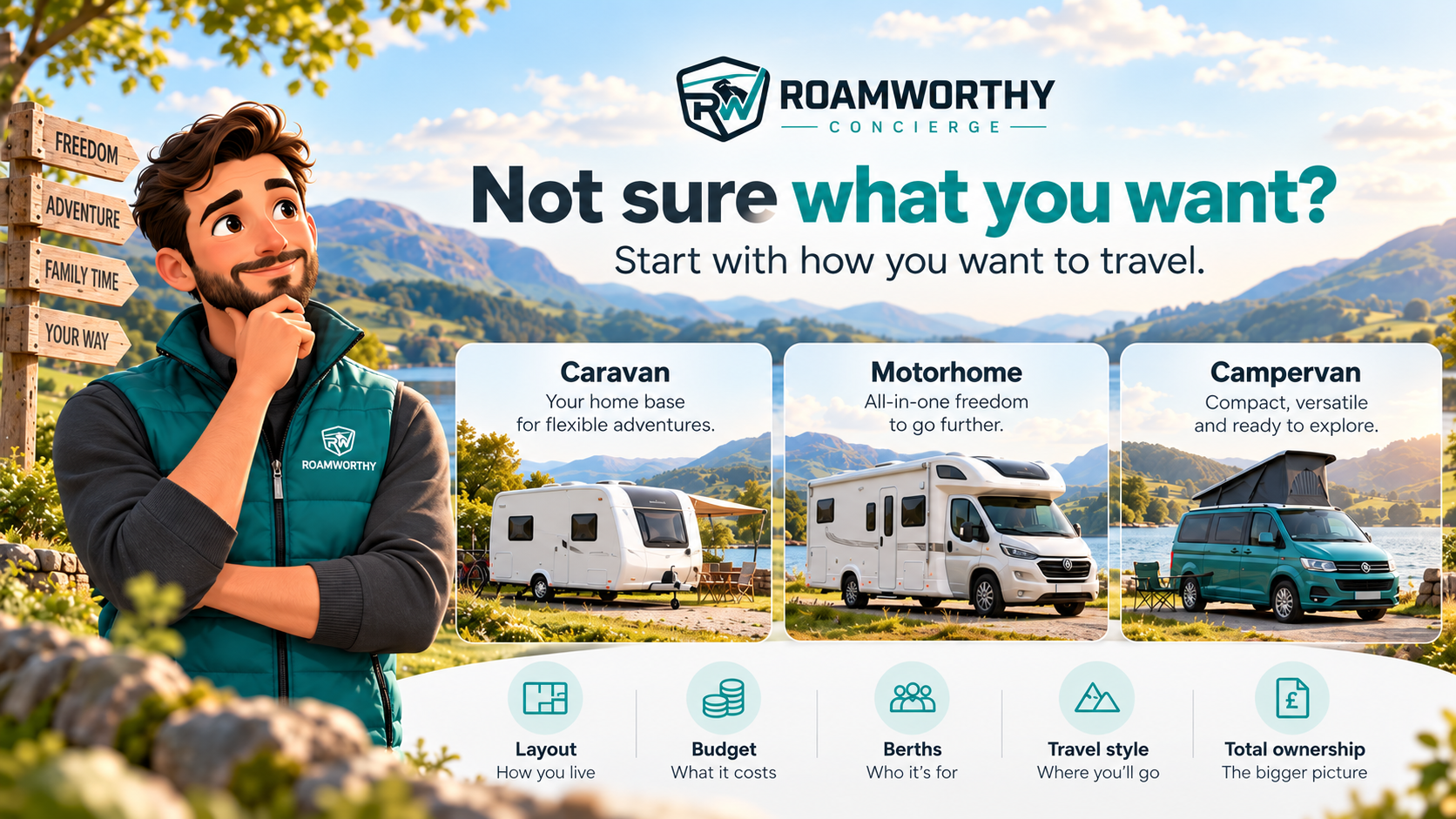
You do not need to know the make, model or even the type of vehicle yet. If you are looking at caravans, motorhomes and campervans and feeling less certain rather than more certain, that is a useful place to start. The best next question is not “Which brand should I buy?” It is “How do I want to travel?”
This guide is for the buyer who has opened ten tabs, saved a few vehicles, changed their mind twice and still cannot quite describe the perfect one. We will help you turn that uncertainty into a useful brief, one decision at a time. Explore as you go, keep the parts that matter and leave the rest open. Your brief does not need to be perfect, and the things you are still unsure about belong in it too.
Tip: the research links in this guide open in a new tab, so you can explore without losing your place here.
- Choose the life before the vehicle. Think about the trips you want to take, how often you will move and who is coming with you.
- Choose the layout before the badge. Beds, lounges, washrooms, storage and travel seats usually matter more day to day than the name on the front.
- Work out your hard limits. Budget, licence, towing limits, parking, storage and payload can rule options in or out quickly.
- Keep an open brief. “Two people, longer European trips, fixed bed, bikes, around £60,000” is already enough to start a useful search.
1. Forget the badge for a moment. What do you want your trips to feel like?
Imagine a normal trip rather than the dreamiest photograph in a brochure. Friday afternoon has arrived. Are you hitching up and driving to one site for the weekend? Are you moving every day or two through France? Are you parking near a beach, making coffee and heading home on Sunday? Are you staying somewhere for a fortnight and using a separate car for day trips?
Those answers tell you far more than a list of manufacturers.
Treat the patterns below as starting points, not rules. A small motorhome may be easier to park than a long campervan conversion, and two vehicles in the same category can feel completely different inside. Once a type starts to look promising, compare the exact layout, dimensions, weights and storage of real candidates.
A quick comparison: notice which travel pattern sounds most like your life.
- Best for: pitching up and staying for a while.
- On site: your tow car is free for days out.
- Space: often generous for the purchase price.
- Trade-off: towing, hitching and storage all need thought.
- Ask yourself: am I comfortable towing and storing it?
- Best for: touring and moving regularly.
- On site: your accommodation travels with you.
- Space: self-contained living with more room than many campervans.
- Trade-off: access and parking need more planning.
- Ask yourself: do I want one vehicle to be both transport and accommodation?
- Best for: spontaneous weekends and mixed-use trips.
- On site: it can double as your everyday transport.
- Space: compact, with less room for living and storage.
- Trade-off: that compactness matters most when everyone is inside.
- Ask yourself: will it still work for us on a wet day?
2. Who is actually coming with you?
“Two berth” and “four berth” sound simple, but the number of beds is only part of the story. Think about who will travel with you most of the time and who might join occasionally.
A couple may still want four-berth space because they value a separate lounge, occasional guests or not making the bed every night. A family may need proper belted travel seats as well as sleeping space. Grandchildren may come on some trips but not others. A dog, two bikes or bulky sports kit can change the storage question completely.
Write down your normal travelling party and your maximum realistic travelling party. That gives you a better brief than simply choosing the biggest berth count you can afford.
3. Now think about how you want to live inside it
This is where many searches become much easier. The layout is the part you will experience every morning, every rainy afternoon and every night.
Ask yourself:
- Do you want a permanent bed, or are you happy converting a lounge every night?
- Do you want an island bed that you can approach from both sides?
- Would fixed single beds suit you better?
- Do you want a large rear lounge where you can relax for hours?
- Is a separate shower important, or would you rather use the space elsewhere?
- Do you need a garage or large external locker for bikes and equipment?
- Will someone need to work from the vehicle?
- Could everyone be comfortable inside on a wet day?
Do not answer these questions from memory. Explore actual layouts and look at what the trade-offs do to the rest of the space. Open the relevant layout hub in a new tab: caravan layouts, motorhome layouts or campervan layouts.
If you are leaning towards a campervan but still do not know your style, the campervan layout quiz can help you start with how you travel rather than a model name.
Once you have narrowed down a few layout ideas online, you need to prove they work in the real world.
4. What are your non-negotiables, and what are merely preferences?
This is one of the most useful distinctions you can make.
A non-negotiable is something that makes a vehicle unsuitable if it is missing. A preference is something you would like but could trade for the right overall vehicle.
Your list might look like this:
- Must have: fixed bed, space for two bikes, automatic gearbox, four belted seats.
- Would like: island bed, rear camera, solar panel, particular upholstery.
- Do not want: bed made from the lounge every night, vehicle over a certain length, towing.
This is the beginning of a genuinely useful brief. It also stops you rejecting a brilliant option because it lacks one feature that was never actually essential.
5. Set two budgets, not one
The purchase price is only the first budget. The second is the cost of owning and using the vehicle comfortably.
Think about the purchase price alongside insurance, servicing and habitation checks, storage if you cannot keep it at home, security, accessories, tyres, fuel, campsite costs, finance interest where applicable and the inevitable first-season purchases. Depreciation matters too, particularly if you expect to change again after learning what works for you.
You do not need a perfect spreadsheet before you browse. You do need a ceiling that still leaves you comfortable after the purchase.
6. Check the limits that can make the decision for you
Some decisions are about taste. Others are about whether the vehicle works with your car, licence, driveway or real payload needs.
If you are considering a caravan, check the exact towing limits of the tow car and the caravan rather than relying on a rule of thumb.[1] RoamWorthy's towing calculator can help you explore the match.
If you are considering a motorhome, look at its plated weight, payload and the driving entitlement you actually hold.[2][3] Use the motorhome weight checker and licence checker as part of the research, then verify the exact vehicle before buying.
For any vehicle, measure the practical limits at home. Think about length, width, height, gates, turning space and where it will live when you are not using it. An amazing vehicle that is awkward to store or stressful to get off the drive is less likely to be used.
7. New or used is not really a question about age
It is a question about what you value most.
New vehicles can offer the latest layouts and the experience of choosing a specification from scratch, and may come with a manufacturer warranty. Check the terms on the exact vehicle rather than assuming every warranty is the same. Used vehicles can open up more vehicle for the same budget and reduce the financial step into ownership. But condition, history, maintenance and the quality of the specific example matter enormously.
If you are still unsure what you want, used stock can be especially useful for research because it exposes you to a much wider range of layouts, ages and specifications. Browse live examples without committing: caravans for sale, motorhomes for sale and campervans for sale.
8. Brand matters, but later than most people think
There is nothing wrong with having a favourite make. Build quality, dealer support, design, construction methods and resale can all matter. The mistake is starting with the badge before you know what you need the vehicle to do.
Once your brief is taking shape, brand research becomes far more useful. Instead of “Which is the best brand?”, you can ask “Which manufacturers build the layout I want, at the size and budget that work for me?”
That is the right moment to explore caravan makes, motorhome makes and campervan makes.
9. How far are you prepared to travel for the right one?
There is a real trade-off here. Buying locally can make viewings, servicing and aftersales support easier. Shopping nationally can give you more choice, especially if your brief is specific.
Do not decide this too early. Start with a radius you would happily travel. If the right vehicle is rare, widen it deliberately rather than letting distance silently remove good options.
Write down a preferred radius and the point at which you would be willing to widen it. That keeps distance as a conscious trade-off rather than an invisible filter removing good options.
10. Turn what you know into a brief
By this point, you may still not know the make or model. That is absolutely fine. A useful brief describes your life, constraints and priorities.
“There are two of us. We want longer UK and European trips and will move every few days. We do not want to make the bed every night. We need space for two bikes, would prefer to stay within standard licence limits, and our comfortable maximum purchase price is around £65,000. We are open on brand.”
That brief is far more useful than “I think I want a Swift” because it tells you what a good match actually has to achieve.
And if all you know is “two people, weekends away, around £30,000, not sure whether we want to tow”, that is enough too.
Here is what that looks like in practice. Build your own brief below.
11. Your brief is allowed to change
The first version is not a contract. You might discover that a fixed bed matters more than you expected, that you are comfortable travelling further, or that the campervan you loved online feels too tight in person. That is progress.
Keep refining the brief as you browse. Remove things that stop mattering. Promote preferences to must-haves when experience proves they matter. Add the practical limits you discover from towing, weights, storage and budget.
You do not need to arrive at the search with the answer. You can arrive with what you know so far, including the things you have not resolved yet.
The interactive brief above is a starting point, not a contract. You can edit it in Concierge before submitting anything and refine the search as you learn more.
If you are ready to move from choosing to buying, continue with our first-time buyer journey from research to keys. If you are not ready, that is exactly what the brief builder is for: keep the uncertainty in the brief and let Concierge work from what you know today.