
Campervan Height and Parking Barriers Car Parks Ferries and Real World Stress
Will your campervan fit? Learn about 2.0m height barriers, ferry surcharges, M6 Toll classes, and the practical differences between pop-tops and high-tops.
Will your campervan fit? Learn about 2.0m height barriers, ferry surcharges, M6 Toll classes, and the practical differences between pop-tops and high-tops.
Ready to find yours?
Put this knowledge into action

The RoamWorthy editorial team combines decades of caravan, motorhome and campervan ownership experience with industry expertise to provide trusted buying advice.
View all articles →The romantic version of campervan ownership involves coastal sunsets and off-grid freedom; the practical version involves height barriers and the sudden realisation that your local supermarket is now a logistical no-go zone. In the UK, height is often a more significant daily hurdle than length, especially as urban planning increasingly uses physical barriers to manage vehicle access in recreational and retail spaces.
Where Height Restrictions Impact Owners
It isn't just about low bridges. Modern urban planning and 'anti-van' measures mean height barriers are more prevalent than ever. Key pinch points include:
- Coastal & Rural Car Parks: Many car parks in National Landscapes (formerly AONBs) use 2.0m or 2.1m barriers to prevent overnight stays. This is common in Cornwall, the Lake District, and the Scottish Highlands.
- Multi-Storey Ramps: Even if the ceiling is high, the 'break-over' angle at the top of a ramp can cause a high-top van to clip structural beams. The British Parking Association (BPA) represents organisations in the parking industry that manage these structures, and while they provide guidance for operators, older structures may be significantly lower than modern standards.
- Drive-Thrus & Petrol Canopies: Older petrol stations often have lower canopies (sometimes as low as 2.5m), which can be a disaster for high-top campervan layouts featuring roof-mounted solar panels or Maxxfans.
- Ferries and Tolls: On routes like Dover-Calais or the M6 Toll, height is a primary pricing tier. Crossing the 2.0m threshold can significantly increase your fare.
| Vehicle Type | Typical Height | Parking Access |
|---|---|---|
| Micro-Camper (e.g. Peugeot Rifter) | 1.8m - 1.9m | Full access (most 1.85m+ lots) |
| Pop-Top (e.g. VW California) | 1.98m - 2.05m | Limited (fits 2.0m if unladen) |
| High-Top (e.g. Crafter/Sprinter) | 2.5m - 3.1m | Outdoor/Oversize only |
Pop-Top vs. High-Top: The Real-World Trade-Off
Choosing between a used campervan with a pop-top and a fixed high-top is the most significant decision regarding accessibility. When browsing campervan makes, you must weigh convenience against comfort.
1. The Pop-Top (Elevating Roof)
Models like the Volkswagen California are designed to sit under the magic 2.0m mark. You can compare these against competitors in our VW vs Ford comparison.
- Pros: Fits in most multi-storeys; lower fuel consumption; usually classed as a 'car' on ferries.
- Cons: Canvas sides offer less insulation; you cannot stand up while the roof is down.
2. The High-Top (Fixed Roof)
Common on larger used motorhomes or bespoke conversions. These offer permanent standing room but require careful route planning.
- Pros: Better thermal insulation; 'stealth' camping is easier; no mechanical roof to operate.
- Cons: Barred from most height-restricted car parks; higher ferry and toll costs.
Understanding Vehicle Weights and Height
According to GOV.UK, there are two critical weight terms that affect how your van sits on its suspension. The Unladen Weight is the weight of the vehicle when it is not carrying passengers or goods, excluding fuel. However, the Mass in Running Order for cars, buses, and lorries includes the driver, essential fluids, and a full tank of fuel.
When you are checking if a van will fit under a 2.0m barrier, you must consider the Maximum Authorised Mass (MAM). This is the weight of the vehicle including the maximum load it can carry safely. A van at its MAM will sit lower on its springs than an unladen one. If you measure your van while it is empty, you may find it is slightly taller than when it is fully packed for a trip.
Urban Access and Emissions Zones
While height itself isn't the primary factor for emissions, larger high-top vans are often built on chassis that fall under different regulatory categories. Transport for London (TfL) operates the Low Emission Zone (LEZ), which is separate from the ULEZ. The LEZ encourages the most polluting heavy diesel vehicles to become cleaner. If your campervan is based on a heavy diesel chassis (often the case for large high-tops), you must check if it meets LEZ standards before entering Greater London, as these zones operate 24 hours a day, every day of the year.
The "Tuesday Test": A Practical Checklist
Before buying from campervan dealers, run through this checklist of your typical week:
- The Supermarket: Does your local shop have a height barrier? Many Lidl and Aldi stores now use 2.0m barriers.
- Home Storage: Will it fit under your carport or through your garage door?
- Hospital/Work Parking: Multi-storey parking is the norm for many hospitals; a high-top may force you to park much further away.
- Tolls: The M6 Toll uses a 1.3m height-at-first-axle rule. Vehicles over this height are charged at a higher rate than standard cars. Most campervans exceed this 1.3m threshold.
Frequently Asked Questions
Do solar panels and roof racks count towards the height?
Yes. Always measure to the highest point. A 1.99m VW Transporter becomes a 2.1m van once you add a roof rack or a solar panel. For more on dimensions, see our motorhome dimensions guide.
Are ferries more expensive for high-tops?
Generally, yes. Most operators use height thresholds to determine pricing. Exceeding 2.0m can move you into a 'Motorhome' category rather than a 'Car' category, increasing the fare significantly on peak-time crossings.
What is the difference between Unladen Weight and Mass in Running Order?
According to GOV.UK, Unladen Weight does not include fuel or batteries (in EVs), whereas Mass in Running Order for cars and lorries includes a full tank of fuel and the driver. This difference can affect your vehicle's actual height on the road.
Does the M6 Toll charge more for campervans?
Yes. The M6 Toll uses a 1.3m height-at-first-axle rule. Because most campervans are taller than 1.3m at the front wheels, they are typically charged at the Class 2 rate, which is higher than a standard car.
What is Maximum Authorised Mass (MAM)?
MAM is the total weight of the vehicle plus the maximum load it can carry safely. This is also known as Gross Vehicle Weight (GVW). It is usually listed in the owner's manual or on a plate fitted to the vehicle.
How do I measure my van accurately?
Measure the van on level ground while it is at its typical travelling weight. Measure to the highest fixed point, such as a TV aerial, roof vent, or solar panel, to ensure you don't fall foul of 2.0m barriers.
Are there height restrictions in London?
While London has many low bridges, the primary concern for van owners is the Low Emission Zone (LEZ). Managed by TfL, this zone covers most of Greater London and targets heavy diesel vehicles. You should check your vehicle's compliance on the TfL website before travelling.
What to do next
- Compare different campervan layouts to see how internal space is affected by roof height.
- Browse used campervans to find models that fit under the 2.0m threshold.
- Check our VW vs Ford comparison for height and dimension data.
- Visit local campervan dealers to measure vehicles in person before committing to a purchase.
Ready to find yours?
Put this knowledge into action
Related Tools
Related Makes & Models
Spotted an error? Let us know.
Continue Reading
More expert guides to help you make informed decisions

Campervan pop tops what to check before you buy
Buying a campervan with a pop-top? Use our 2026 expert inspection guide to check canvas condition, safety locks, and weatherproofing before you buy.

Pop-top or high-top and what you trade off
Choosing between a pop-top and high-top campervan? Compare insulation, height barriers, and storage to find the perfect roof for your UK adventures in 2026.
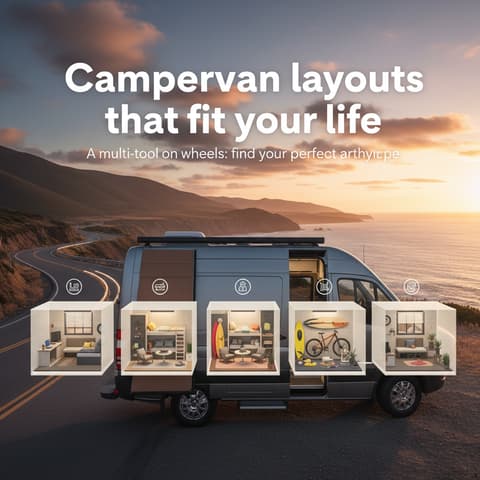
Campervan layouts that fit your life
Choosing the right campervan layout is critical for UK vanlife. From side-kitchen Weekenders to fixed-bed Explorers, find the perfect configuration for 2026.