Key Takeaways
- Legal Mandate: If your caravan is wider than your car, you are required to fit extension mirrors to ensure an adequate rear view.
- Penalties: Failure to comply can result in 3 penalty points and a fine of up to £1,000.
- Visibility Standard: You must be able to see clearly down both sides and 4m wide at a point 20m behind the driver.
- Quality Matters: Reliable brands like Milenco are widely used for stable, vibration-free mirrors in the UK.
- Solo Driving: It is recommended to remove towing mirrors when you are not towing to avoid exceeding permitted vehicle width.
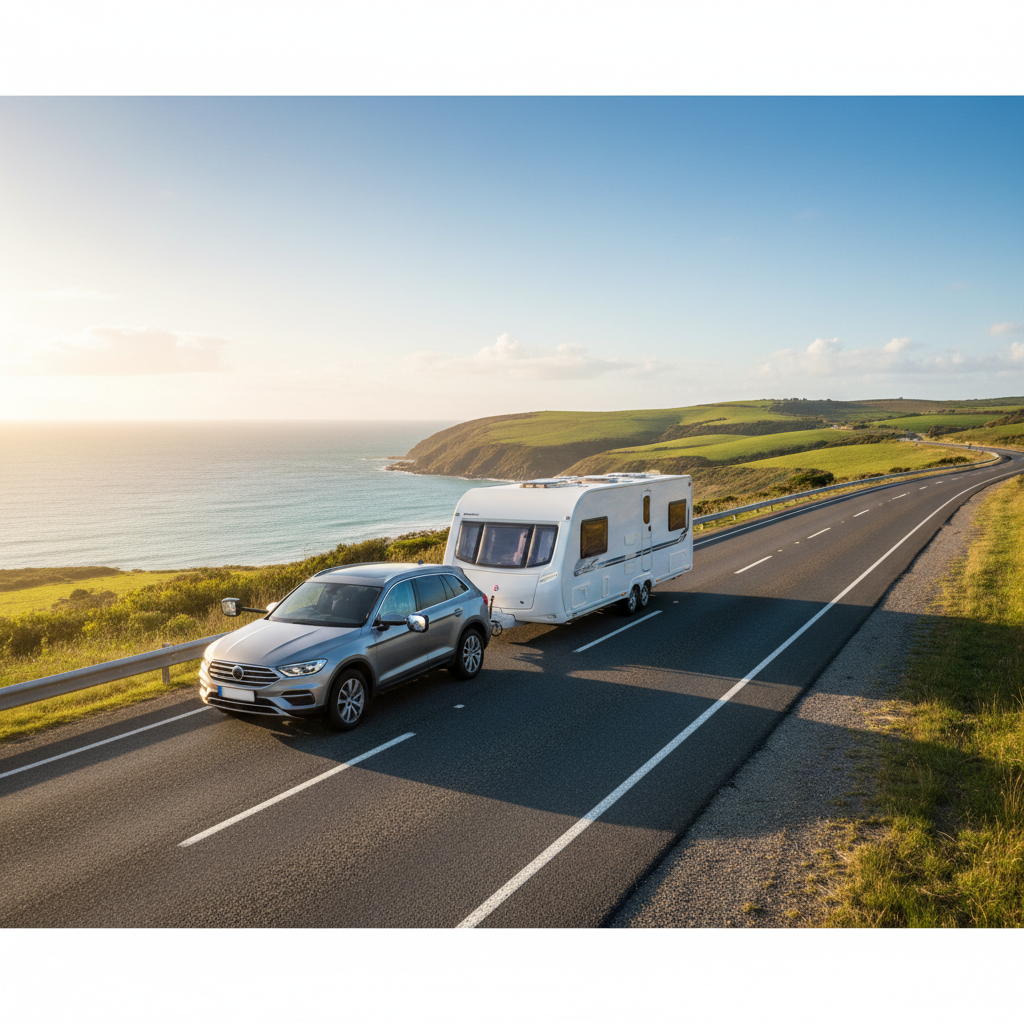
As the 2026 touring season approaches, road safety authorities continue to remind drivers that mirrors are a critical part of towing compliance. It is a common misconception that if you can 'see a bit' of the caravan in your standard car mirrors, you are meeting legal requirements. In reality, the legal standard for visibility is specific. For the safety of cyclists, pedestrians, and other motorists, ensuring you have an adequate view is an essential part of your pre-trip routine.
RoamWorthy prioritises safety and legal accuracy. Our verification team ensures that our equipment advice aligns with current Road Vehicles (Construction and Use) Regulations. Before setting off, ensure your car is up to the task by using our Caravan Towing Calculator.
The Legal Requirement in the UK
The law states that you must have an adequate view of the road behind you. Specifically, you must be able to see an area 4 metres wide at a point 20 metres behind the driver. Because many modern caravans, such as a Bailey Pegasus Grande SE Turin or Swift Challenger 645, are typically 2.3m to 2.5m wide, they are almost always wider than the car towing them. This often applies even to large SUVs like the Volkswagen Touareg.
| Requirement | Legal Standard |
|---|---|
| Field of Vision | 4m wide at 20m behind the driver |
| Certification | Must be 'E-marked' (EC 2003/97 or UNECE Regulation 46) |
| Penalty | Up to £1,000 fine & 3 points |
| Protrusion | Max 20cm beyond the widest part of the outfit (or 25cm if wider than 2.3m) |
A wider trailer can create a blind spot that standard car mirrors cannot cover. If you are found towing without suitable mirrors that provide the required field of vision, you could face a fine of up to £1,000 and 3 points on your licence. Mirrors must be E-marked to be legal for use on UK roads. If you are towing a wider model like the Bailey Alicanto, standard mirrors are unlikely to meet the legal threshold. For more on matching your car to your caravan, see our Caravan Models hub.
Choosing the Right Mirrors
In the UK market, several brands are noted for their stability and ease of use. At RoamWorthy, we suggest investing in high-quality mirrors to minimize vibration at speed. When selecting mirrors for wider caravans, the surface area and arm length are critical factors. You can browse various Caravan Layouts to check width specifications before purchasing your mirrors.
- Milenco Aero and Grand Aero: These use a clamping system designed to attach to most car mirror housings. The 'Grand Aero' features a larger head that can be beneficial for wide 'Grande' caravans like the Bailey Pegasus range.
- Repusel: These mirrors are often used by drivers of large SUVs or those towing 8ft-wide caravans, offering various arm lengths to ensure visibility.
Convex vs. Flat Glass
Most towing mirrors are available with either flat or convex glass. Choosing between them depends on your preference for spatial awareness:
- Flat Glass: Provides a more traditional representation of distance but a narrower field of view.
- Convex Glass: Curved glass provides a wider field of view, which can help in spotting vehicles in adjacent lanes, though it makes objects appear further away than they actually are.
Many modern mirrors use a slight 'multi-curvature' glass to balance these attributes. For those towing with a Volkswagen Transporter or similar van-based vehicle, mirrors with a longer arm may be required to clear the body of the caravan. If you are converting a van for towing, check our Campervan Conversion Checker for weight and dimension compliance.
Best Practice
Before you set off, perform a visibility check. Sit in the driver's seat and have a partner stand at the rear corner of the caravan; you should be able to see them clearly. If you are unsure of your outfit's dimensions, use our Towing capacity by reg tool to ensure your vehicle is matched to your caravan. If you are still looking for the perfect match, check out our Find a Dealer tool.
Mirror Safety Checklist
- Check the Clamps: Ensure the rubber pads are clean to prevent scratching your car's paint and to ensure a firm grip.
- Tighten by Hand: Avoid using tools to tighten mirror clamps to prevent damage to the car's mirror housing.
- Security Tether: Use a safety cord if provided to prevent the mirror from falling if a clamp becomes loose.
- Fold with Caution: If your car has 'auto-fold' mirrors, check that the extensions do not contact the door glass when folded.
- Remove when Solo: It is best practice to remove extension mirrors when you are not towing, as they may cause the vehicle to exceed permitted width limits.
Frequently Asked Questions
Do I need mirrors if I have a rear-view camera?
Yes. A camera is a useful aid but does not replace the legal requirement for physical mirrors in the UK. The law requires a specific field of view provided by mirrors, and current regulations do not recognize cameras as a total substitute for external mirrors on the towing vehicle.
What if my car mirrors fold automatically?
You can usually disable the 'auto-fold' feature in your car's settings while towing to prevent damage to your mirrors or the vehicle body when parked.
Are suction-cup mirrors legal?
They can be legal if they are E-marked and provide the required field of vision, but many towers find clamp-on versions to be more stable against vibration and wind resistance.
For more essential gear, check our emergency kit guide to ensure your trip is compliant and safe.
