
Motorhome licence bands and why 3,500kg is a cliff edge
Understand the 3,500kg motorhome 'cliff edge'. Learn how UK licence laws, payload traps, and speed limits change once you cross the 3.5-tonne MAM threshold.
Understand the 3,500kg motorhome 'cliff edge'. Learn how UK licence laws, payload traps, and speed limits change once you cross the 3.5-tonne MAM threshold.
Ready to find yours?
Put this knowledge into action

The RoamWorthy editorial team combines decades of caravan, motorhome and campervan ownership experience with industry expertise to provide trusted buying advice.
View all articles →- The 3,500kg Limit: This is the Maximum Authorised Mass (MAM) threshold that separates a standard car licence (Category B) from a medium-sized vehicle licence (Category C1).
- The 'Grandfather Rights' Factor: If you passed your car test before 1 January 1997, you likely have C1 automatically. If after, you are restricted to 3,500kg unless you pass an additional C1 test.
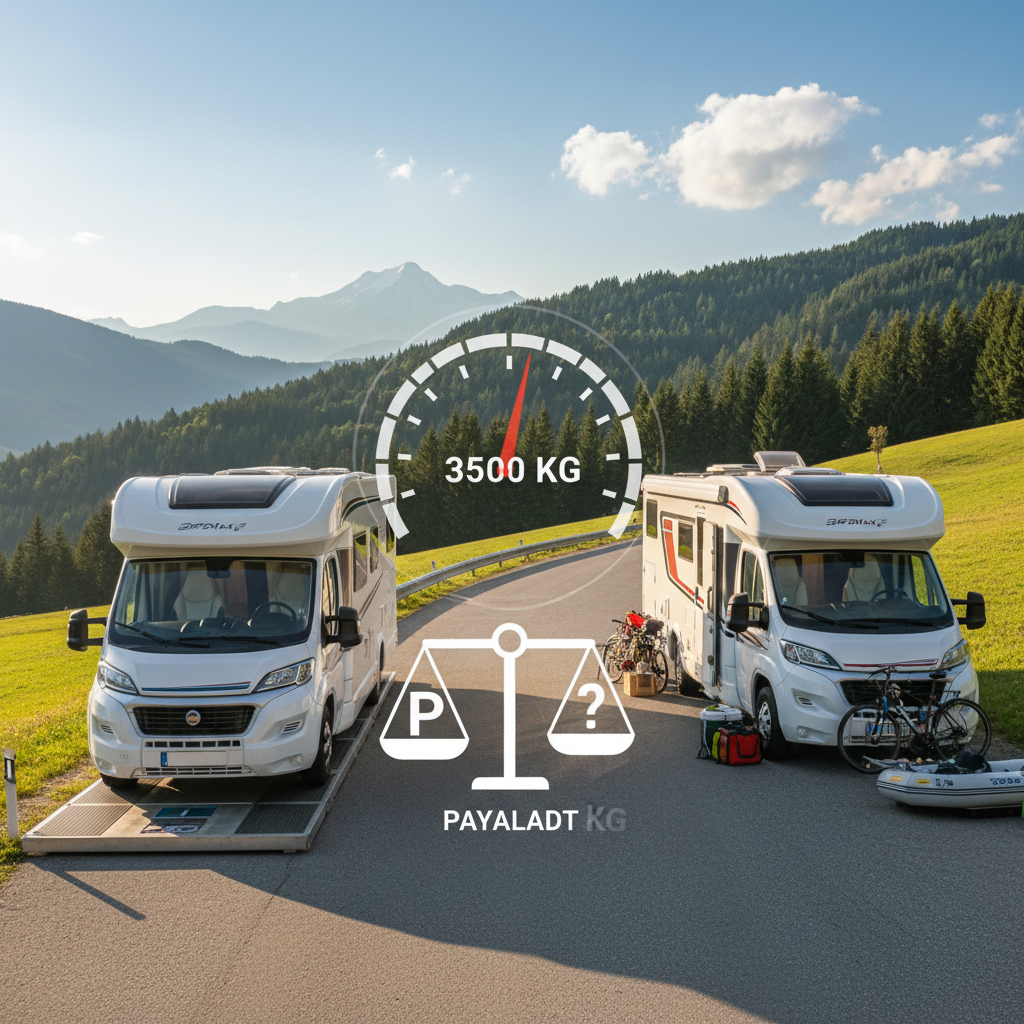
- The Payload Trap: Many large motorhomes are plated at 3,500kg to attract more buyers, but this often leaves very little 'user payload' for passengers, water, and gear.
- Age 70 Milestone: At 70, you lose C1 entitlement unless you pass a medical (D4 form) and submit a D2 application to the DVLA.
Why 3,500kg is the 'Cliff Edge' of Motorhoming
In the UK, 3,500kg (3.5 tonnes) is the most significant figure in the motorhome industry. It is known as the Maximum Authorised Mass (MAM)—the total weight of the vehicle plus its maximum load. Crossing this line changes your legal requirements, your running costs, and even your potential resale value.
1. The Licence Divide: Category B vs. C1
The primary reason 3,500kg is a cliff edge is the UK driving licence categories. The rules depend entirely on when you obtained your full car licence:
- Passed before 1 January 1997: You usually have 'grandfather rights' and hold a Category C1 licence. This allows you to drive vehicles up to 7,500kg. However, you must renew this entitlement at age 70 via a medical.
- Passed on or after 1 January 1997: You are restricted to Category B, meaning you can only drive vehicles up to 3,500kg. To drive anything heavier, you must pass a C1 theory and practical driving test.
Before buying, use our Motorhome Weight Checker to ensure your chosen model matches your licence. If you are converting a van yourself, ensure you use our Campervan Conversion Checker to track your build weight.
2. The Payload Pressure
Manufacturers, such as Bailey, Swift, and Auto-Trail, work incredibly hard to keep large motorhomes like the Auto-Trail Imala or Bailey Autograph 69 2 under the 3,500kg limit. Why? Because it opens the vehicle up to the widest possible pool of buyers.
However, this creates a "payload squeeze." If a motorhome has an unladen weight of 3,100kg, you only have 400kg left for passengers, fuel, water, gas bottles, and personal kit. For a four-berth family van, this is dangerously thin. Adding a bike rack or an awning can easily eat up 50kg-80kg before you've even packed a suitcase.
3. Speed Limits and Regulations
Once a motorhome exceeds 3,050kg unladen weight (not MAM), different speed limits apply on UK roads. For vehicles over 3,500kg MAM, the following usually applies:
- Dual Carriageways: 60mph (instead of 70mph).
- Single Carriageways: 50mph (instead of 60mph).
- Motorways: Generally remains 70mph unless specified otherwise or towing.
Furthermore, vehicles over 3,500kg may face higher tolls on the continent (such as the Swiss Heavy Vehicle Charge) and different MOT testing requirements (Class 4 vs Class 7 depending on specific build specs).
The Common Shopping Mistake: "Paper Weight"
Many buyers choose a van that is 3,500kg on paper but find it impossible to stay legal in practice. If you plan to add extras like solar panels or a second leisure battery, you may quickly exceed your MAM. High-end brands like Niesmann And Bischoff or Le Voyageur often build on heavy-duty chassis (4,500kg+) specifically to avoid these compromises.
Checklist: Before You Buy
- Check your licence: Look at the back of your photocard for the 'C1' code and the expiry date.
- Verify the 'Mass in Running Order' (MRO): This is the weight of the van with basic essentials (usually including a 75kg driver and 90% fuel). Subtract this from 3,500kg to find your actual payload.
- Consider the 'Up-plating' option: Some vans can be paper-uprated to 3,650kg or 3,850kg for a small fee (often via specialists like SV Tech), giving you more payload if your licence allows it.
- Think about resale: While 3,500kg vans sell faster, a 4,250kg van offers a much more relaxed touring experience for those with the right licence.
Practical Advice for 2026 Buyers
If you are looking for a high-quality van that fits under the 3,500kg limit, you might consider the Volkswagen California or compact models from Carado or Adria. For those with C1 licences, larger models like the Bailey Alicanto Grande Porto provide significantly more internal luxury without the constant worry of a weighbridge. You can browse motorhomes under 3,500kg here to see what fits your criteria.
Frequently Asked Questions
Can I drive a 3,500kg motorhome on a standard licence?
Yes, anyone with a full UK Category B licence can drive a motorhome up to 3,500kg MAM.
What happens if I am overweight?
If stopped by the DVSA and found to be over your MAM, you can face on-the-spot fines (graduated based on the % overweight), penalty points, and you will likely be prohibited from moving until the vehicle is within legal limits.
Does the 3,500kg limit include the trailer?
The 3,500kg limit refers to the vehicle's MAM. If you are towing, you must also consider the Gross Train Weight (GTW). Check our Caravan Towing Calculator for more details on combined weights and B+E entitlements.
What happens when I turn 70?
Your C1 entitlement expires. To keep it, you must pass a D4 medical examination by a doctor to prove you are fit to drive larger vehicles. This must be repeated every 3 years.
Ready to find yours?
Put this knowledge into action
Related Tools
Related Makes & Models
Spotted an error? Let us know.
Continue Reading
More expert guides to help you make informed decisions
C1 Licence Medical for Motorhome Drivers Explained
Everything you need to know about the C1 driving licence medical for motorhomes over 3,500kg. Costs, D4 forms, and age 70 renewal rules explained for 2026.
Guide to the 3500kg Motorhome Payload Challenge
Master the 3,500kg motorhome payload challenge. Learn how to stay legal, calculate MRO, and manage weights for your 2026 UK touring season.
Motorhome over 70 renewals what to check before a big trip
Planning a motorhome trip after 70? Learn how to renew your C1 licence, navigate D4 medicals, and ensure your 3,500kg+ motorhome remains legal for 2026 travel.