Key Takeaways
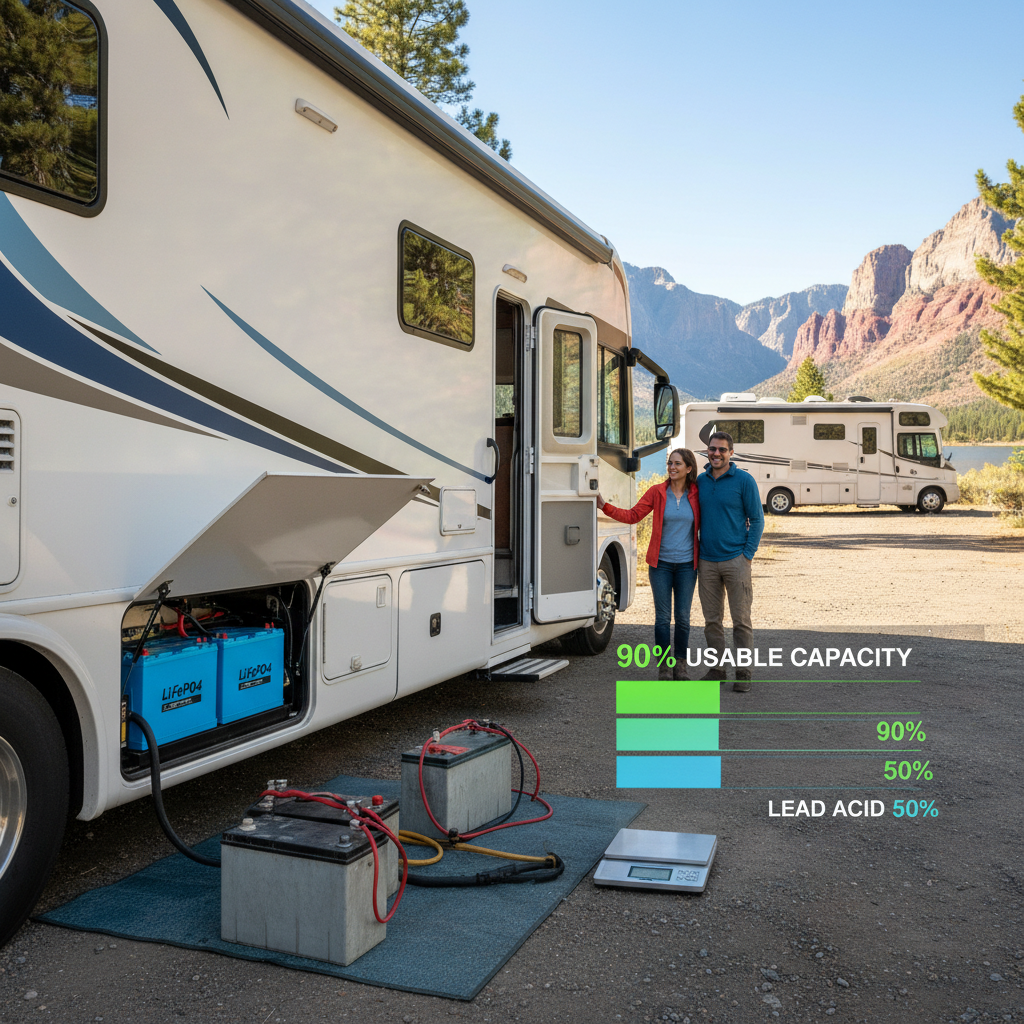
- Usable Capacity: Lithium (LiFePO4) batteries offer up to 90% usable capacity compared to just 50% for traditional Lead Acid.
- Weight Savings: They are significantly lighter, typically saving between 20kg and 40kg of user payload—ideal for those nearing the 3,500kg limit.
- Voltage Stability: Lithium batteries maintain a steady voltage (around 13V) until they are almost completely depleted.
- Essential Hardware: A DC-DC charger is mandatory to protect your engine's alternator and ensure the battery receives the correct charging profile.
- Long-Term Value: Whilst the initial cost is higher, a 10-year lifespan (3,000+ cycles) often makes them cheaper than lead-acid over time.
In the 2026 motorhome market, the most frequent technical enquiry isn't about engines or layouts—it's about "Going Lithium." As more owners seek off-grid independence to avoid rising campsite fees, the traditional lead-acid leisure battery is being replaced by Lithium Iron Phosphate (LiFePO4) technology. Lithium is no longer a niche upgrade for expedition rigs; it is becoming the standard for any serious tourer. However, you cannot simply "swap" batteries; a lithium upgrade requires a systematic approach to your vehicle's charging electronics. At RoamWorthy, our verification team focuses on the engineering reality of power management.
Why Lithium Wins: Weight and Capacity
The primary advantage of lithium in 2026 is its impact on your motorhome payload. A standard 100Ah lead-acid battery weighs around 25kg, but you can only safely use 50Ah of its power before risking permanent plate damage. In contrast, a 100Ah lithium battery weighs just 12kg and provides 90Ah of usable power. This means you get nearly double the power at half the weight.
For owners of vehicles like the Swift Lifestyle, Auto-Trail Imala, or a Bailey Autograph 74 4 struggling with the 3,500kg payload challenge, switching to a dual-lithium setup can "buy back" 30kg of payload for essential gear or water. This is particularly relevant for those converting a Volkswagen Transporter where every kilogram counts. You can use our Campervan Conversion Checker to see how battery weight impacts your build.
| Feature | Lead-Acid (AGM/GEL) | Lithium (LiFePO4) |
|---|---|---|
| Usable Capacity | 50% | 80-90% | Weight (per 100Ah) | ~25kg - 30kg | ~10kg - 13kg | Cycle Life | 300 - 600 cycles | 3,000 - 5,000 cycles | Voltage Profile | Steady decline | Flat until empty |
The DC-DC Charger: The Mandatory Component
You must never connect a lithium battery directly to a modern Euro 6 engine's "smart" alternator. Lithium batteries have a very low internal resistance and will try to "pull" as much current as possible. This can cause the alternator to overheat and fail, particularly at low engine speeds. A DC-DC Charger (such as those from Victron or Renogy) acts as a buffer, controlling the flow of current to a safe level and providing the specific multi-stage profile that lithium cells require. This should be integrated into your annual maintenance and upgrade rhythm.
Winter and Heat Considerations
Whilst lithium offers superior performance, it has specific temperature sensitivities. Most LiFePO4 batteries cannot be charged if the internal cell temperature is below 0°C, though they can still be discharged to power your lights and heating. In 2026, many premium batteries now feature internal heating elements that use a small amount of incoming current to warm the cells before charging begins. Conversely, in summer, ensure your battery compartment is well-ventilated; efficiency and lifespan can drop once temperatures exceed 45°C. For more on managing your rig in the sun, see our solar and heat guide.
The Lithium Upgrade Audit
- Charger Compatibility: Does your existing 230V mains charger have a dedicated "Lithium" profile? If not, it may fail to fully charge the battery or apply an incorrect voltage.
- Solar Controller: Ensure your MPPT controller is programmed for lithium. Check our solar guide for configuration tips.
- BMS (Battery Management System): Ensure the battery has a high-quality internal BMS to protect against short circuits, over-voltage, and temperature extremes.
- Monitoring: Install a "Battery Shunt" (like a Victron BMV or SmartShunt) so you can monitor your exact state of charge via a smartphone app.
- Cabling: Verify that your existing cables can handle the potential high-current discharge of lithium, especially if using an inverter.
Expert Installation and Sourcing
Upgrading to lithium is a complex task involving high-current DC electrics. We recommend using our Find a Dealer tool to locate an AWS-approved workshop with specialist electrical expertise. If you are looking for a vehicle that already features these advanced systems, such as a high-spec Niesmann And Bischoff, a Le Voyageur, or a Frankia Platin, browse our motorhome models and look for "off-grid" specifications. For those looking at smaller builds like the Volkswagen California or Mercedes-Benz Marco Polo, lithium is often the only way to achieve multi-day autonomy.
Frequently Asked Questions
Is lithium safe in a motorhome?
Yes, provided you use LiFePO4 (Lithium Iron Phosphate). This chemistry is significantly more stable and less prone to "thermal runaway" than the cobalt-based lithium-ion batteries used in older mobile phones or some electric cars.
Will a lithium battery last longer?
Yes. A quality lead-acid battery might last 300–500 charge cycles if well-maintained. A LiFePO4 battery is typically rated for 3,000 to 5,000 cycles. For the average motorhomer, this means the battery will likely outlast the vehicle itself.
Can I use my existing wiring?
Not necessarily. Because lithium can handle higher currents, you must ensure your cabling is of a sufficient gauge (thickness) to prevent overheating and voltage drop. Always consult a professional for a cable-size audit.