    RoamWorthy
    guide
    caravan
    license weight
    towing
    85-percent-rule
    safety
    matching

    Understanding the 85 Percent Towing Rule for Safe Touring

    Master the 85% towing rule for safer caravan touring. Learn how to calculate your match, understand UK legal limits, and ensure your outfit stays stable.

    Master the 85% towing rule for safer caravan touring. Learn how to calculate your match, understand UK legal limits, and ensure your outfit stays stable.

    5 min read
    Published 15 Apr 2026Updated 5 Jun 2026

    Key Takeaways: Towing Safety at a Glance

    • The 85% Rule: A safety recommendation from the Caravan and Motorhome Club, not a legal requirement.
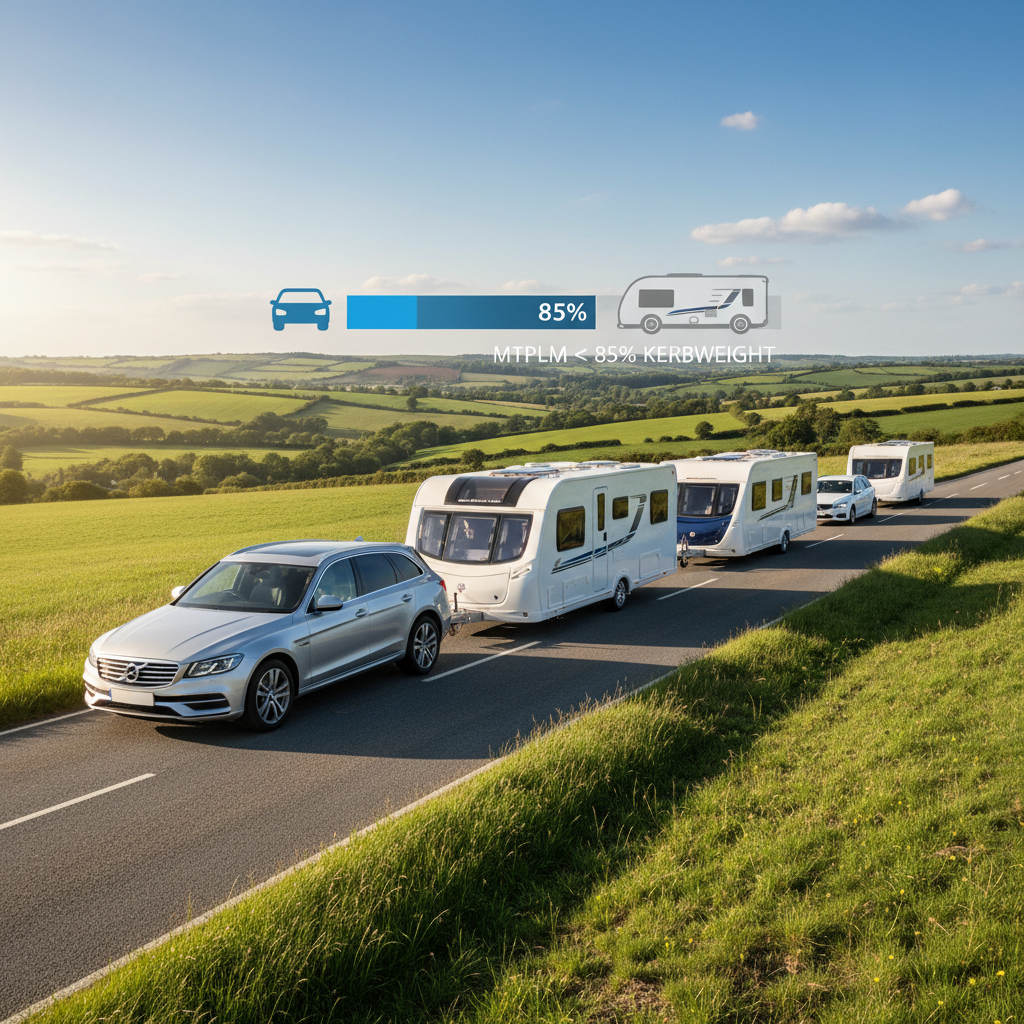
    • The Calculation: Your caravan's MTPLM should ideally not exceed 85% of your car's kerbweight (Mass in Service).
    • Stability First: Adhering to this ratio significantly reduces 'snaking' risks and improves braking performance.
    • Experience Matters: Only experienced towers should consider ratios up to 100%, provided they stay within legal braked towing limits.
    • Check the V5C: Always use the 'Mass in Service' figure from your V5C logbook for the most accurate kerbweight data.

    As we move through April 2026, many first-time caravanners are preparing their outfits for the touring season. For decades, the "85% rule" has been the cornerstone of towing advice in the UK. However, with modern cars becoming lighter due to hybrid technology and caravans like the Bailey Pegasus Grande GT75 Portofino becoming wider, does this old rule of thumb still hold weight? Understanding the distinction between what is legal and what is safe is the most critical lesson for any tower.

    At RoamWorthy, our verification process ensures all safety guidance is aligned with the Caravan and Motorhome Club and the British Tyre Manufacturers’ Association (BTMA).

    What is the 85% Rule?

    The rule is a safety guideline: for a stable tow, the Maximum Technically Permissible Laden Mass (MTPLM) of your caravan should be no more than 85% of the kerbweight of your car. For example, if your car has a kerbweight of 2,000kg, you should ideally tow a caravan weighing no more than 1,700kg.

    Car Kerbweight 85% Recommended Limit 100% Maximum (Experienced)
    1,400kg 1,190kg 1,400kg
    1,600kg 1,360kg 1,600kg
    1,800kg 1,530kg 1,800kg
    2,000kg 1,700kg 2,000kg

    Why 85%? The Physics of Stability

    When you tow, the caravan acts as a giant pendulum. If the caravan is too heavy relative to the car, it can begin to dictate the car's movement. In situations like a sudden crosswind on a viaduct or being overtaken by a large HGV, a heavy caravan can cause the car to 'snake' (oscillate). If this oscillation is not dampened by the car's mass, it can lead to a total loss of control. Sticking to 85% ensures the car remains the 'boss' of the outfit, providing the necessary inertia to pull the caravan back into line.

    Is it Law? Understanding UK Regulations

    No. There is no UK law that specifically mentions the 85% figure. Legally, you can tow up to 100% of your car's braked towing capacity (which you can check using our registration lookup tool). However, legal limits and safety limits are not the same. If you are involved in an accident and your outfit is found to be unstable, the police can charge you with "driving a vehicle in a dangerous condition" under the Road Traffic Act. Furthermore, many insurance providers refer to the 85% guideline when investigating claims involving high-speed instability.

    The Impact of Modern Tech: AL-KO ATC and iATC

    In 2026, many premium caravans, such as the Swift Challenger 645 or the Bailey Unicorn Cartagena, come fitted with electronic stability systems like AL-KO ATC (Active Trailer Control). These systems use sensors to detect the earliest signs of a snake and apply the caravan brakes automatically to tension the outfit and straighten it. Whilst these are life-saving technologies, they are 'fail-safes' and should not be used as an excuse to ignore safe weight matching. A balanced outfit is always safer than an unbalanced one relying on electronic intervention.

    Calculating Your Match Accurately

    To calculate your match, you must use specific figures rather than estimates:

    1. Car Kerbweight: Found in your V5C logbook (usually listed under G: Mass in Service). This includes a 90% full fuel tank and a 75kg driver.
    2. Caravan MTPLM: Found on the weight plate (usually near the door) or in the manufacturer's handbook. This is the maximum the caravan can weigh when fully loaded.

    You can skip the manual maths and use our Caravan Towing Calculator, which performs these checks instantly and accounts for your driving licence category and B+E requirements.

    The Ultimate Towing Stability Checklist

    • Noseweight: Ensure the downward force on the towball is roughly 5-7% of the caravan's loaded weight. Never exceed the car's specific towball limit (found on the towbar plate or manual).
    • Tyre Pressures: Check both car and caravan tyres whilst cold. For towing, car rear tyres often require significantly higher pressures; refer to the 'loaded' section of your vehicle's pressure placard.
    • Loading Strategy: Place heavy items like awnings or battery packs on the floor, directly over the axle. Avoid heavy items in high lockers or at the extreme rear of the caravan.
    • Towing Mirrors: Extension mirrors are a legal requirement if your caravan is wider than the rear of your car. Read our mirror safety guide for more.

    Finding the Right Match for Your Licence

    If you are still in the process of matching a car and caravan, use our tow car database to find vehicles with high kerbweights. If your current car is too light for a heavy twin-axle model, you can browse Caravan Models to find lightweight alternatives from brands like Bailey Discovery or Swift Basecamp that offer a safer 85% match.

    Frequently Asked Questions

    Can I ever tow at 100%?

    The Caravan and Motorhome Club suggests that experienced towers (those with several years and thousands of miles of experience) can tow up to 100% of the car's kerbweight. However, this requires a perfectly balanced outfit. For anyone with less than three years of towing experience, 85% remains the gold standard.

    Does an empty fuel tank affect safety?

    Yes. Since the 'Mass in Service' includes fuel, towing with a nearly empty tank reduces the car's actual weight, thereby increasing the towing ratio and potentially reducing stability. Always aim to tow with at least half a tank of fuel.

    What if my car's legal limit is lower than 85% of its weight?

    You must never exceed the car's legal braked towing limit. Some cars, particularly smaller SUVs or EVs, have legal towing limits significantly lower than their kerbweight. The legal limit is the absolute ceiling set by the manufacturer for the chassis and drivetrain integrity.

    Before your next trip, consider a practice day to build your confidence. See our towing practice routine for a structured approach to your first outing. If you are unsure about your vehicle's specific limits, use our Towing Capacity by Reg tool for peace of mind.

    Can your car tow it?

    Free towing check. Takes 30 seconds

    Try the RoamWorthy towing calculator
    PDF Report

    Save outfits, compare setups, download or email a PDF report. Find compatible caravans.

    Our content follows our editorial policy.

    Spotted an error? Let us know.