Quick answer
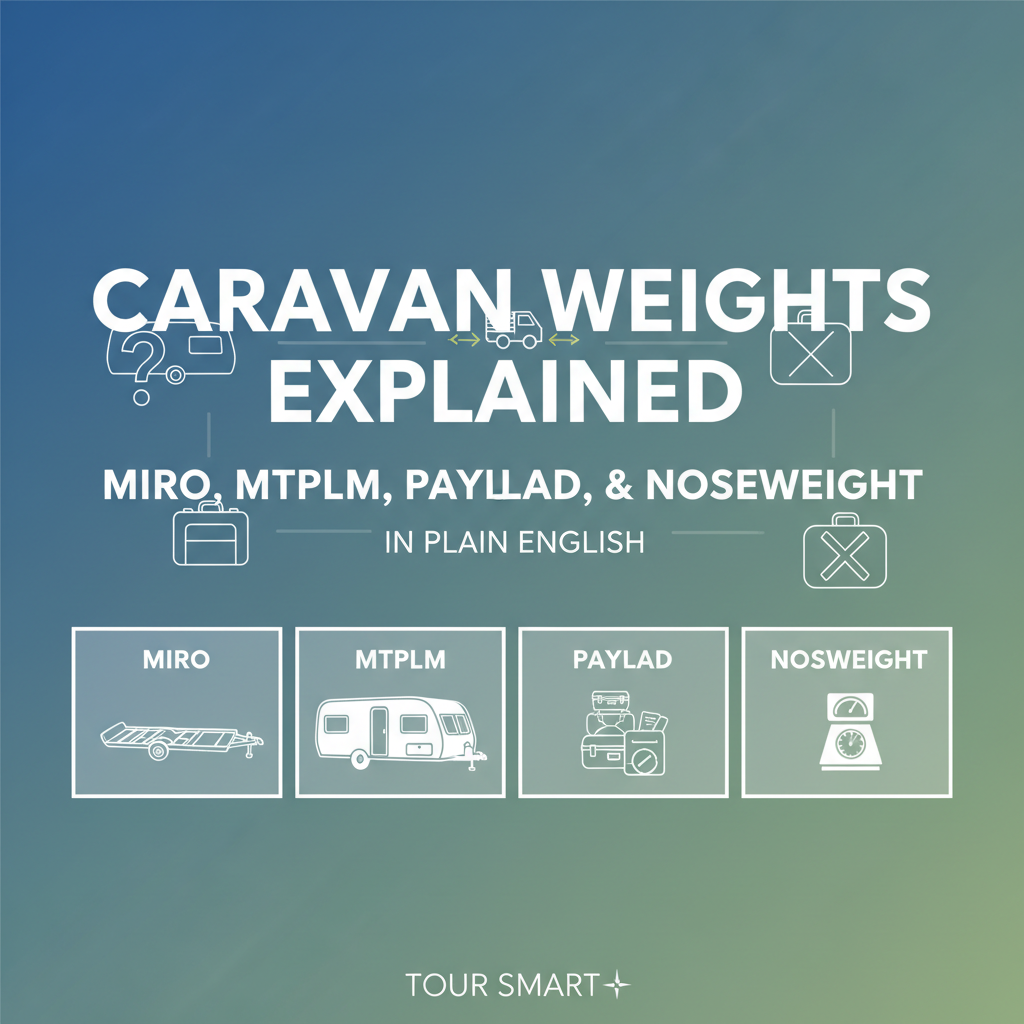
Four numbers decide whether your outfit is safe and compliant: MIRO, MTPLM, payload, and noseweight. MIRO is generally the weight of the caravan as it left the factory under specific industry standards. MTPLM is the maximum the caravan is allowed to weigh fully loaded. Payload is the difference between the two. Noseweight is the downward force the caravan hitch puts on the towball, typically aimed at around 5 to 7 percent of the loaded caravan weight. Before you tow, check all four against your car's braked towing capacity and plated limits.
Who this is for
Anyone matching a caravan to a tow car for the first time, or anyone whose car or caravan has changed and needs a fresh check. If you have not run the numbers, start with our towing capacity by registration lookup and our towing calculator.
MIRO, Mass in Running Order
MIRO is a manufacturer's stated weight of the caravan, typically including standard fittings and a defined level of fluids and gas. Exact definitions can vary by the year of manufacture and the specific standard (such as BS EN 1645-1) used. It is shown on the chassis plate and in the handbook. Two important caveats:
- MIRO is calculated to specific standards, so it may not include factory-fit options, dealer-fit extras, awnings, motor movers, lithium upgrades or anything you load.
- Real-world unloaded weight can be several tens of kilograms above the quoted MIRO once options are fitted. If accuracy matters, a public weighbridge is the reliable way to verify the actual weight.
MTPLM, Maximum Technically Permissible Laden Mass
MTPLM is the absolute legal upper limit for the caravan when loaded. Exceeding it may affect your insurance cover or claims and could lead to prosecution. It is shown on the chassis plate. Some caravans can be uprated by the chassis maker (typically AL-KO or BPW) within published limits. Uprating can give you more usable payload, but it does not change the legal towing capacity of your vehicle.
Payload, the number that matters in real life
Payload is MTPLM minus MIRO. It is everything you can add to the caravan: clothes, food, water, gas, awnings, bedding, bikes, the motor mover, and the leisure battery. On a modern two-berth, headline payload is usually between 130 and 200 kg, but options eat into that figure quickly. A few typical deductions:
- Motor mover, around 35 kg
- Awning packed, 25 to 45 kg
- Full water tank, 40 to 90 kg depending on capacity
- Two full gas bottles, around 30 kg
- Leisure battery, 15 to 30 kg
Add it up before you buy, and verify the final loaded weight at a weighbridge.
Noseweight
Noseweight is the downward force the caravan hitch applies to the car's towball. It matters for stability: too light and the van can pitch and yaw; too heavy and you risk overloading the rear axle of the car. Typical guidance is to aim for around 5 to 7 percent of the loaded caravan weight, subject to the lower of the caravan's noseweight limit, the car's towball nose limit, and the towbar rating. Use a noseweight gauge, not a guess. Our noseweight and stability guide walks through measuring it properly.
Matching the car
The car's braked towing capacity is often on the V5C, but the VIN plate is the primary reference for gross vehicle and gross train weights. You must check the gross train weight (car plus trailer) on the manufacturer's plate. Two common benchmarks:
- The 85 percent guideline, where the loaded caravan is kept within about 85 percent of the car's kerbweight. This is widely promoted by UK clubs as guidance for stability, not as a legal limit. See our 85 percent towing rule explained.
- The legal limit, which includes the car's braked towing capacity and plated weight limits. Never exceed these.
Licence categories
Great Britain car-and-trailer towing rules changed in December 2021. If you passed your car driving test (Category B) at any time, you can now tow a trailer up to 3,500kg MAM. You no longer need to pass a separate B+E test for ordinary car towing. However, you must still ensure your vehicle and trailer stay within their legal weight limits. Different rules apply to motorhomes over 3,500kg. Confirm your category on the GOV.UK towing with a car page.
Practical pre-tow checklist
- Confirm MIRO and MTPLM from the chassis plate.
- Confirm your car's braked towing capacity and gross train weight from the VIN plate.
- Use the towing calculator to model the match.
- Weigh the loaded van periodically at a public weighbridge to verify actual loaded weights and axle limits.
- Measure noseweight with a gauge, loaded as you would tow.
- Fit suitable towing mirrors if the caravan is wider than the rear of your car. Failure to have an adequate rear view can lead to a fine of up to £1,000 and 3 penalty points.
- Check tyre pressures and the four-digit DOT code on the tyre sidewall.
Editorial note: weight rules and licence categories are subject to change. Confirm current limits against GOV.UK and the plated data of the specific caravan and car you are using.