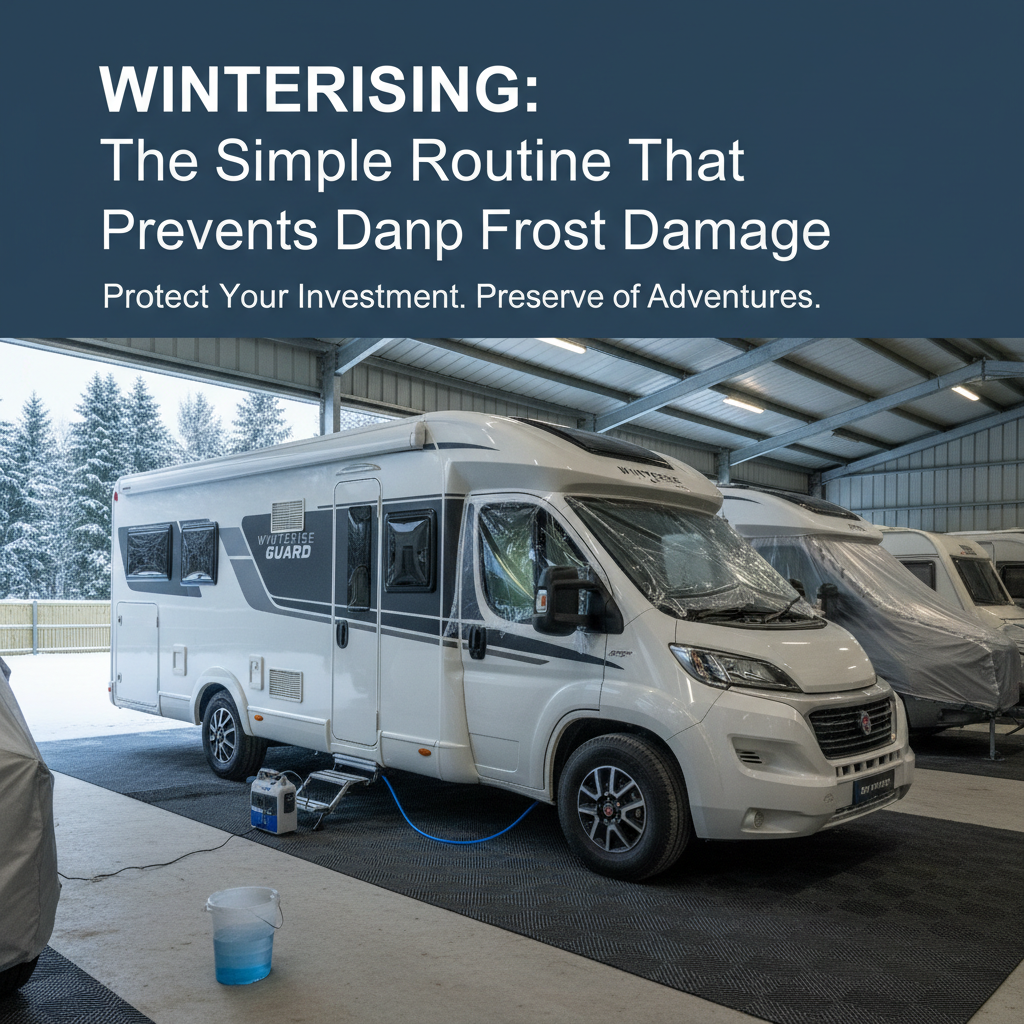
TL;DR: Winterising is the essential process of preparing your leisure vehicle for the UK's damp, freezing months. By following a simple routine of draining water systems, managing ventilation, and maintaining batteries, you can prevent catastrophic frost damage and costly damp issues. Spend 45 minutes now to save thousands in spring repairs.
- Drain Everything: Water expands when frozen; empty tanks, heaters, and taps to prevent split pipes.
- Airflow is King: Ventilate cupboards and prop up cushions to stop condensation turning into mould.
- Battery Care: Keep leisure batteries charged or isolated to prevent permanent cell damage.
- Check Seals: Inspect window and rooflight seals for cracks before the heavy rain starts.
- Fuel & Tyres: For motorhomes, store with a full tank and check tyre pressures to avoid flat spots.
Winterising is not a complex or dramatic undertaking. Rather, it is a small set of habits designed to prevent two of the most expensive problems in the industry: damp and frost damage. Because water expands when it freezes, even a small amount of residual liquid in a plastic pipe can cause a split. Similarly, stagnant air leads to condensation, which eventually manifests as mould and structural damp.
Your goal is simple: drain what can freeze, and ventilate what can trap moisture.
Who this guide is for
Whether you own a luxury Bailey Alicanto, a compact Volkswagen California, or a classic Swift Challenger, this routine applies to you. It is essential for owners who store their vehicles over the winter months, as well as year-round tourers who need to protect their investment between trips. If you are currently browsing used caravans for sale, knowing how a previous owner winterised the unit is a key indicator of its overall health.
The Reality Check: Why bother?
Most "mystery leaks" discovered in the spring are actually the result of winter water system failures that went unnoticed. A hairline crack in a whale pump or a split mixer tap can cost hundreds of pounds to replace, whilst a damp check guide reveals that moisture left to fester over four months can write off an older vehicle entirely. Following a consistent maintenance schedule is the best way to preserve your vehicle's resale value.
The Core 2026 Winterising Routine
1. The Water System (The 'Drain Down')
This is the most critical step. Gravity is your friend here. For those with complex setups, using a Caravan Towing Calculator to ensure you aren't carrying excess water weight during your final trip home is also good practice.
- Open all taps: Set mixer taps to the central position (between hot and cold) and leave them open. This prevents pressure build-up and allows air to enter the system.
- Drain the heater: Locate your water heater's safety drain-off valve (usually a yellow flipper switch) and flip it up. For Lunar or Buccaneer models with Alde systems, ensure you follow the manufacturer's specific sequence to avoid airlocks.
- Empty the tanks: Ensure the fresh water tank and waste (grey) water tanks are completely empty. Leave the external drain valves open.
- Shower head: Unscrew the shower head and hose, shake out the water, and leave it lying in the shower tray.
- Cassette Toilet: Empty and clean the Thetford or Dometic cassette. If your model has a dedicated flush tank, drain it fully. Lubricate the blade seal with a dedicated silicone spray to prevent it from sticking in the cold.
- External Pumps: If you use an external submersible pump, dry it thoroughly and store it inside the vehicle.
- Pro Tip: Drive a short distance with the drain valves open (where legal and safe) to allow the motion to 'slosh' out any remaining trapped water.
2. Moisture and Ventilation
Damp thrives in still, cold air. You want to encourage airflow whilst removing anything that holds moisture.
- Soft Furnishings: If possible, remove cushions and mattresses and store them in a dry place at home. If not, stand them on their edges (the 'A-frame' position) to allow air to circulate around all sides. This is particularly important in tighter Caravan Layouts where air pockets are common.
- Fridge: Clean the interior and leave the door slightly ajar using the 'winter catch' to prevent mould.
- Cupboards: Open all interior locker doors and wardrobes to prevent stagnant air pockets.
- Dehumidifiers: Whilst some use moisture traps (crystals), be aware they require regular emptying. Never leave an electric dehumidifier running unattended unless it is specifically rated for such use and has a continuous drain-off.
3. Exterior and Seals
Before the first frost, inspect the 'envelope' of your vehicle. This is especially vital for older models from Abi, Sterling, or Swift.
- Visual Inspection: Check the seals around rooflights and windows. Look for any signs of cracking in the sealant.
- Cleaning: Wash the exterior to remove algae and bird droppings, which can damage the finish over time. Consider a breathable winter cover, but ensure it is specifically designed for your model (e.g., a tailored fit for a Coachman or Adria) to avoid paint chafing.
- Security: Ensure all window catches are fully engaged and locks are lubricated with a dry graphite spray. If you are storing away from home, check our Find a Dealer directory for secure storage sites.
4. Battery and Electricals
Leisure batteries do not like being left discharged in freezing temperatures. A flat battery can freeze at much higher temperatures than a charged one, leading to permanent cell damage.
- Charge Schedule: If you have a solar panel, ensure it is kept clear of snow and debris. If not, try to hook the vehicle up to mains power for 24 hours once a month.
- Isolation: If you cannot charge the battery, consider removing it and storing it in a cool, dry place on a trickle charger. Note: Check if your alarm or tracker requires the battery to stay in situ for insurance compliance.
Motorhomes and Campervans: The Extra Layer
Motorhomes like the Auto-Trail Apache or Bürstner Lyseo require mechanical attention. Use the Motorhome Weight Checker to ensure you aren't exceeding limits if you've added heavy winter covers. If you are using a self-build, consult the Campervan Conversion Checker to ensure your insulation and plumbing are up to standard.
- Tyres: Increase pressures to the recommended 'storage' psi to prevent flat spots, or move the vehicle slightly every few weeks. Check the GOV.UK vehicle safety guidelines for tyre age and condition advice.
- Fuel: It is often recommended to store with a full tank of fuel to reduce condensation build-up inside the tank.
- Engine Fluids: Ensure your engine coolant has the correct concentration of antifreeze (typically a 50/50 mix for UK winters).
- Wipers: Pull wiper blades away from the glass or wrap them in plastic to prevent them from sticking to the windscreen.
Printable Winterising Checklist
- [ ] Drain down water system fully (taps, shower, heater, and tanks)
- [ ] Open all taps to the middle position
- [ ] Empty and clean the toilet cassette; lubricate seals
- [ ] Remove or prop up soft furnishings (cushions/mattresses)
- [ ] Leave fridge door ajar on the winter catch
- [ ] Open all internal locker doors and wardrobes
- [ ] Clean exterior and inspect window/rooflight seals
- [ ] Check tyre pressures and condition
- [ ] Set a monthly reminder to charge the leisure battery
- [ ] Ensure engine antifreeze is at the correct level (Motorhomes/Campervans)
Frequently Asked Questions
Should I leave my heating on low all winter?
Whilst some modern systems like Alde have a 'frost' setting, it can be expensive in gas or electricity. A full drain-down is a more reliable and cost-effective method for most owners. If you do leave it on, ensure you have a constant power/gas supply and adequate ventilation.
Can I use automotive antifreeze in my fresh water pipes?
NO. Never put automotive antifreeze in your fresh water system. It is toxic. If you must use an additive, use only non-toxic 'food grade' antifreeze specifically designed for leisure vehicle water systems.
How do I stop pests getting in?
Check for gaps around floor vents and pipe entries. Some owners use fine mesh to cover vents, but ensure you do not block essential gas drop-out vents, as this is a safety requirement.
Is a cover better than no cover?
A high-quality, breathable cover protects against UV and bird lime, but a cheap, non-breathable tarp can trap moisture and cause more harm than good. Ensure any cover is secured tightly to prevent wind-rub.